Autonomous AI Agents for On-Chain Capital: Governed Execution Architecture
How autonomous AI agents manage on-chain capital with cryptographic policy enforcement. The Agentic Control Plane enforces governance at the signing layer.
Giving an AI agent a wallet is not the hard part. Governing what it does with it is.
Autonomous AI agents are now executing on-chain transactions — managing treasury positions, settling payments, rebalancing portfolios, and paying for compute — at speeds and volumes that make human review loops structurally impossible. The tooling that makes this technically feasible has outpaced the infrastructure required to govern it safely. An agent with a wallet has capability. An agent with a wallet and no policy enforcement layer has liability.
DeAgenticAI’s Agentic Control Plane enforces cryptographic policy over AI agent authority, separating what an agent can do from what it is authorized to do — in Web3 and enterprise financial environments.
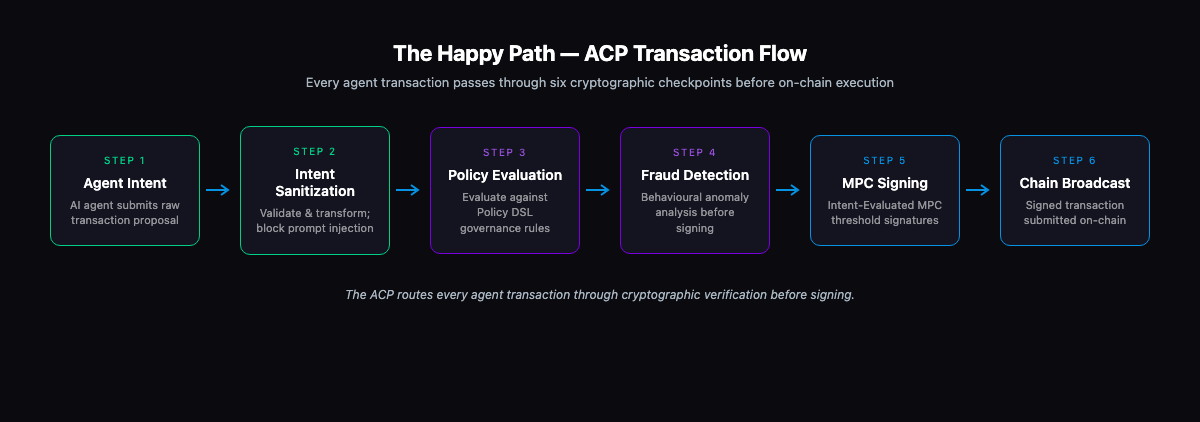
The ACP routes every agent transaction through six cryptographic checkpoints before any on-chain execution occurs.
Why Autonomous Agents Need More Than a Wallet
The first instinct when building an autonomous agent that handles capital is to provision it with a wallet. This is the correct instinct — and it is approximately 5% of the solution.
A wallet gives an agent the means to hold and transact. It does not tell the agent what it is authorized to do. It does not enforce spending limits. It does not validate that the transaction proposed is within policy. It does not check whether the instruction was prompt-injected. It does not create an audit trail.
The gap between “agent has a wallet” and “agent has governed on-chain capital access” is the entire governance stack. Without it, you have autonomous execution with no enforcement boundary. As agent frameworks proliferate and more teams connect AI models to live on-chain accounts, the failure modes accumulate: agents that spend beyond mandate, agents that interact with protocols they were never authorized to use, agents that execute prompt-injected transactions in production. Each is an architectural failure requiring an enforcement layer between the agent and the signing event.
The Structural Problem: Infrastructure Built for Human Signers
The custody and signing infrastructure that exists today was built for human signers. This is the root cause — not a gap in any particular product, but an architectural mismatch between the tools and the threat model.
Multisig wallets, hardware security keys, Gnosis Safe, Fireblocks custody — these are excellent tools for human-operated capital management. They assume that a human reviews each transaction, that signing events are discrete and infrequent, and that the primary attack vector is unauthorized external access. They answer: “Did the right person authorize this?”
Autonomous agents invert every one of these assumptions. They execute at machine speed — tens to hundreds of transactions per hour — with no human in the loop. They receive instructions from other AI systems, from API outputs, from dynamic inputs that may themselves be compromised. The relevant threat model is not “did the right person authorize this?” but “is this transaction consistent with the policy this agent is supposed to operate under?”
Existing custody tools have no answer to that question. They enforce signature authorization — they do not enforce policy authorization. Software-level guardrails address part of this gap, but exist above the signing layer. A compromised model or a prompt injection attack can bypass them entirely.
What autonomous agents require is policy enforcement at the key level — cryptographic enforcement independent of the agent code, the model, and the orchestration layer. The signing should not occur unless the transaction is demonstrably within the policy the agent was authorized to execute.
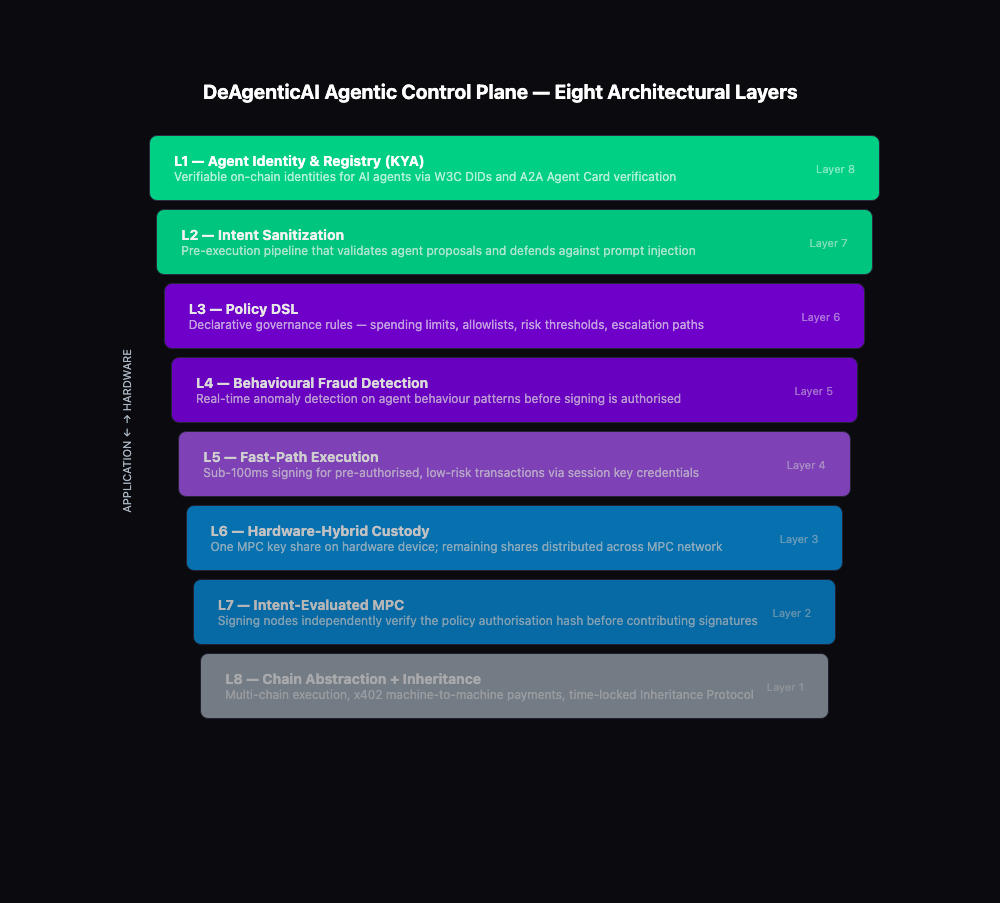
The ACP Framework: Eight Layers of Cryptographic Agent Governance
The Agentic Control Plane (ACP) closes this gap by enforcing policy at the signing layer — not as a software check that can be bypassed, but as a cryptographic condition of the signing event itself. Every transaction an AI agent proposes must pass through the ACP’s enforcement stack before it receives a signature.
The eight architectural layers of the Agentic Control Plane, from agent identity verification to multi-chain execution.
L1 — Agent Identity and the KYA Registry
Before any transaction is executed, the agent must exist as a verifiable entity. Know Your Agent (KYA) is the identity and credentialing framework establishing on-chain identities for autonomous AI agents — anchored to W3C DIDs and supporting A2A Agent Card verification for multi-agent ecosystems.
Every agent in a governed deployment has a registered identity — the anchor for all downstream authorization: the policy that applies to this agent, the signing scope it has been granted, the audit log that records its actions. An agent without a registered identity cannot reach the signing layer.
In multi-agent systems — where one agent delegates to another — the KYA registry enables agent-to-agent trust verification. An orchestrating agent can verify a sub-agent’s identity and authorization scope before acting on its instructions, preventing attacks where a compromised or impersonated agent injects instructions into a trusted pipeline.
L2 — Intent Sanitization: Blocking Prompt Injection Before Signing
Intent Sanitization is DeAgenticAI’s pre-execution pipeline that blocks prompt injection attacks before any agent proposal reaches the signing layer.
When an AI agent receives input from external sources — user messages, API responses, tool outputs — an adversarial actor can embed instructions that hijack the agent’s behavior. Intent Sanitization validates and transforms raw agent proposals into structured, policy-evaluable intents before they reach the signing layer — removing the natural language ambiguity that makes injection attacks possible. An intent that does not conform to the schema does not proceed.
L3 — Policy DSL: Declarative Rules Enforced at the Key Level
DeAgenticAI’s Policy DSL is a declarative domain-specific language defining AI agent governance rules — including spending limits, protocol allowlists, risk thresholds, time windows, and escalation paths — enforced cryptographically at signing time.
The Policy DSL produces a policy authorization hash evaluated at the signing layer. An MPC signing ceremony will not produce a valid signature unless the transaction is consistent with the policy hash. The policy is not advisory — it is a cryptographic pre-condition of the signature. Even if the agent code is compromised or the orchestrator is subverted, the signing ceremony will not authorize a transaction that violates policy.
Policy rules are composable: spending limits (maximum value per execution and per time window), protocol allowlists (which contracts this agent may interact with), risk thresholds (gas limits, slippage parameters), time windows (when this agent may execute), and escalation paths (transactions above a threshold require a human counter-signature).
L5 & L7 — Fast-Path Execution and Intent-Evaluated MPC
Fast-Path Execution enables sub-100ms signing for pre-authorised, low-risk transactions using session key credentials — bypassing the full MPC signing ceremony while remaining within the authorised policy context. Session keys are scoped and time-bounded — they cannot be used outside the policy parameters they were issued for.
Intent-Evaluated MPC (Layer 7) is the second cryptographic verification gate. MPC signing nodes independently verify the policy authorisation hash before contributing their partial signatures. This verification is independent of the orchestrator: even if the orchestrator is compromised, the signing nodes will not contribute to a signature for a transaction without a valid policy hash. There is no single point of failure.
How DeAgenticAI Implements Governed On-Chain Agent Execution
The ACP is the architecture. DeAgenticAI’s implementation makes it deployable in the time it takes to integrate an SDK — not in the time it takes to build a custody system.
Register agent identity — establish a W3C DID-anchored identity for each agent. In multi-agent systems, this includes sub-agents. The registry handles A2A Agent Card verification for agent-to-agent trust chains.
Define policy in the DSL — write governance rules once: spending limits, protocol allowlists, risk thresholds, time windows. A policy for a DeFi treasury agent: max_single_tx: 10_ETH, protocols: [uniswap-v3, aave-v3], window: weekdays_09:00-17:00_UTC, escalation_above: 50_ETH.
Deploy session key credentials — issue scoped session keys for high-frequency operations. Sub-100ms signing for pre-authorised transaction types within policy parameters.
Connect via MCP or A2A — the ACP integrates natively with MCP and A2A agent communication standards. Agents connect through the same protocols they already use. No bespoke integration layer required.
Hardware-Hybrid Custody — one MPC key share on a physical hardware device (Ledger, YubiKey, or HSM); remaining shares distributed across the MPC node network. No cloud-based attack can unilaterally move funds.
For teams building on LangChain, AutoGen, or CrewAI: call the API, define the policy, issue a session key. The cryptographic enforcement runs at the infrastructure layer — you do not need to implement key management to ship a governed agent product. This is the “Stripe for Agentic Wallets” model.
Who Deploys Autonomous On-Chain Agents — and How
ICP 4 — AI Web3 Startup CTO: Shipping Without the Infrastructure Debt
You are building an AI agent product that needs to execute on-chain transactions — managing a DeFi strategy, executing trades, paying for compute, settling positions on behalf of users. Your investors are asking about key management. Your enterprise pilots are asking about compliance. Your timeline does not accommodate building a custody system from first principles.
The ACP closes this gap. Policy is defined in the DSL in hours. Session keys are issued in minutes. The agent connects through MCP — the same protocol it already uses for tool calls. The cryptographic audit trail answers every investor due diligence question about agent security. The team that would have spent three months building key management infrastructure ships in days. No vendor lock-in: the ACP is self-hostable and built on open standards (W3C DIDs, A2A, MCP).
ICP 2 — Web3 Fund / Quant Lead: Provable Compliance for Autonomous Trading
Your fund runs autonomous trading agents executing on-chain. LP agreements specify investment mandates. Regulatory requirements demand provable compliance. Key management is a single-point-of-failure risk you cannot accept at your AUM scale.
Policy-at-the-key-level means the investment mandate is enforced cryptographically on every transaction — not as an application-layer check, but as a condition of the signing event. An agent cannot execute a trade that violates the mandate even if the model produces the instruction. The audit log of every signing event is exportable for LP reporting and regulatory review. Intent-Evaluated MPC with Hardware-Hybrid Custody eliminates the key management single-point-of-failure without adding latency to the execution path.
ICP 6 — AI Infrastructure Engineer: On-Chain Payments Without Blockchain Expertise
You are building a multi-agent system that needs on-chain accounting or service payments. One agent pays another for compute. A data feed charges per query. The settlement layer is on-chain because the economics work — but your team has no blockchain expertise and does not want to acquire it.
x402 machine-to-machine payments are integrated into the ACP’s Chain Abstraction layer. Agents pay for APIs, compute, and data feeds without human intervention, subject to the full policy and fraud detection enforcement stack. The integration is an API call, not a blockchain engineering project.
Add a governed on-chain wallet to any agent framework — LangChain, AutoGen, CrewAI — in 3 API calls. No blockchain expertise required.
Go Deeper: Autonomous AI Agent Resources
How AI Agents Execute On-Chain Transactions — step-by-step walkthrough of the ACP transaction lifecycle, from agent proposal to on-chain execution
AI Agent Wallet Security — the multi-layer security architecture preventing unauthorized agent transactions, including prompt injection defence and Hardware-Hybrid Custody
Building Autonomous Trading Agents — policy design and execution patterns for algorithmic on-chain agents with provable compliance
Multi-Agent Systems and On-Chain Capital — governance patterns for agent-to-agent delegation, trust chains, and the KYA registry in multi-agent deployments
Get Started: Governed Agent Wallets Without the Infrastructure Debt
Building an AI agent product with on-chain capital access does not require building custody infrastructure. The ACP provides governance-grade signing, policy enforcement, and agent identity as an SDK integration — deployable in days, not months.
Define your governance policy in the DSL. Issue session key credentials. Connect through MCP or A2A. You ship the product; the ACP governs the execution.
To add governed on-chain payments to a multi-agent system: integrate x402 machine-to-machine payments through the Chain Abstraction layer in 3 API calls. No blockchain expertise required.
How do autonomous AI agents manage on-chain capital?
DeAgenticAI’s Agentic Control Plane enforces cryptographic policy over AI agent authority, separating what an agent can do from what it is authorized to do. Agents submit transaction proposals that pass through Intent Sanitization, Policy DSL evaluation, Behavioural Fraud Detection, and Intent-Evaluated MPC signing before any on-chain execution occurs.
What is the difference between a smart contract wallet and an AI agent wallet?
A smart contract wallet enforces rules at the contract layer. An AI agent wallet governed by the ACP enforces policy at the signing layer, before the transaction is ever submitted on-chain.
How does DeAgenticAI prevent an AI agent from executing unauthorised transactions?
The ACP enforces authorization at three independent layers: Intent Sanitization blocks malformed or injected proposals; the Policy DSL rejects any transaction outside the agent’s declared governance rules; and Intent-Evaluated MPC requires signing nodes to independently verify the policy authorization hash.
What is Intent Sanitization and why do autonomous agents need it?
Intent Sanitization is DeAgenticAI’s pre-execution pipeline that validates and transforms raw AI agent proposals into structured, policy-evaluable intents — defending against prompt injection attacks and ensuring that only well-formed, policy-compliant actions reach the signing layer.
Can autonomous AI agents operate on multiple blockchains simultaneously?
Yes. The ACP’s Chain Abstraction layer provides multi-chain execution under a unified governance policy. The Policy DSL can specify per-chain rules — different allowlists, spending limits, and time windows for each chain.
How does Fast-Path Execution work for pre-authorised agent transactions?
Fast-Path Execution issues session key credentials that authorize sub-100ms signing for transactions within pre-specified policy parameters, bypassing the full MPC signing ceremony while remaining cryptographically within the authorized policy context.
What compliance guarantees does cryptographic policy enforcement provide?
Policy enforcement at the key level means every on-chain transaction executed by an agent carries a verifiable record that it was authorized under a declared governance policy. The ACP produces an auditable signing log for every transaction — exportable for LP reporting, regulatory review, or internal compliance documentation.
Shape the Control Layer for Agentic AI
Our early access is invite-only. Join the design partner waitlist to track DeAgenticAI's progress and shape governed autonomous execution with our team. No marketing fluff-just infrastructure updates.
You have been added to the waitlist.
Something went wrong. Please try again.
By joining, you agree to receive updates about our platform. No spam, ever.